Chapter 12 — Reasons for Government Intervention in Markets
Cambridge International AS & A Level Economics (9708) · Unit 3.1 · 4th edition coursebook
Learning objectives
- Define market failure and explain its causes.
- Explain the non-provision of public goods.
- Explain the underconsumption of merit goods and overconsumption of demerit goods.
- Explain why governments control prices in markets.
Key terms
- market failure
- When the free market does not make the best use of scarce resources.
- public good
- A good that is non-rivalrous and non-excludable; the market will not supply it because of the free rider problem.
- merit good
- A good that is under-consumed in a free market because consumers undervalue its benefits or it generates positive externalities.
- demerit good
- A good that is over-consumed in a free market because consumers undervalue its costs or it generates negative externalities.
- information failure
- Where consumers or producers lack the information needed to make decisions that produce an efficient outcome.
- government intervention
- Government action to influence or override market outcomes — e.g. taxes, subsidies, price controls, direct provision.
12.1What is market failure?
When markets work efficiently, they produce the best allocation of resources. In reality, markets do not always operate as theory predicts. When this happens, there is market failure — an inefficient allocation of goods and services in which the price mechanism does not make the best use of scarce resources.
Market failure occurs when the price mechanism fails to take all of the costs and benefits of producing or consuming a product into account, or when consumers lack the information to make informed choices. The principal microeconomic situations where market failure occurs and government intervention is required are:
- lack of public goods (see Section 6.3)
- underproduction of merit goods (see Section 6.4)
- overconsumption of demerit goods (see Section 6.4)
- information failure on the part of buyers or sellers

The price system can allocate only goods that are excludable and rivalrous, so users who refuse to pay can be denied them. Public goods are non-excludable and non-rival, so free-riders prevent profitable supply – the price mechanism cannot operate. Option D – the provision of public goods by the government – is the case where price fails. The other three are all private-market transactions.
12.2How governments intervene in markets
Public goods (national defence, street lighting, the protection of property rights, non-toll roads and flood control) generate the same problem in every country: their nature means the market under-supplies them. They are non-rivalrous (one person's consumption does not reduce another's) and non-excludable (non-payers cannot be excluded). The free rider problem means no profit-seeking firm will supply them at the socially optimal level. Government provision, funded by tax, is the typical solution.
For merit goods (education, healthcare), consumers tend to undervalue the long-term private benefit and the positive externalities. The free market under-provides them. Governments typically use subsidies, direct state provision, or compulsion (e.g. compulsory schooling).
For demerit goods (tobacco, alcohol, sugary drinks, gambling), consumers underestimate the private cost or impose negative externalities on others. The free market over-provides them. Governments respond with taxes, regulation, advertising restrictions, or outright bans.
Information failure reinforces both problems — consumers may not know the long-term health benefit of vaccination, or the long-term cost of smoking.

Cycling generates positive externalities such as less congestion, lower emissions and better public health, which individual consumers do not factor into their decisions. Option C – consumers are unaware of the external benefits – identifies this externality-based justification for subsidies. A is a private cost, B is an affordability issue (not externality), and D refers to negative not positive externalities.
12.3Controlling prices in markets
Governments also see occasions when they must control prices in the market. Even where the market for a product is functioning well, the social outcome may be unacceptable. Two cases are most common:
- Maximum prices (price ceilings) are set below the equilibrium price, typically to make essentials affordable to low-income households — rent controls, basic food, transport. The diagrammatic consequence is excess demand and queues or rationing (Figure 12.2 shows the effect of an unsuccessful agricultural maximum price).
- Minimum prices (price floors) are set above the equilibrium price, typically to support producers (agricultural price floors) or to set a fair wage (minimum wage). The diagrammatic consequence is excess supply — unsold goods or, in the labour market, unemployment.
The full diagrammatic analysis of both is developed in Chapter 13.
End-of-chapter practice
Past-paper questions from CIE 9708. Pick A, B, C or D. Answers are saved on this device — press Download report (PDF) at the top to save them.
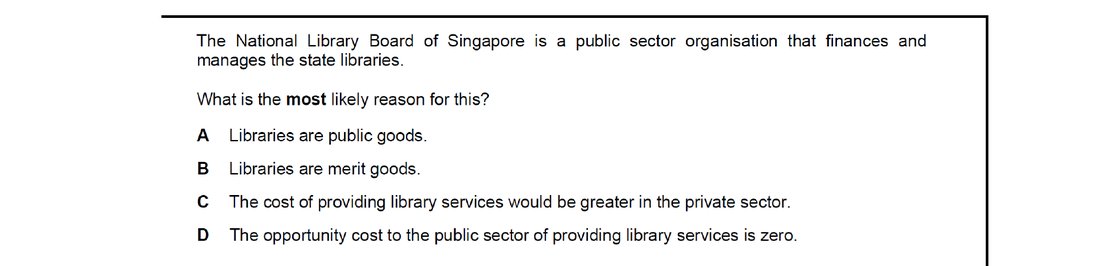
Libraries provide both private benefits (to the reader) and substantial external benefits (literacy, civic engagement) that individuals undervalue. They are excludable and rivalrous, so they are not public goods, but they are typically under-consumed in a free market – the definition of a merit good. Option B – libraries are merit goods – is the standard justification for state provision.

Public goods are non-excludable: once provided, no one can be stopped from consuming them. This creates the free-rider problem, so private firms cannot recover costs through prices and will not supply them. Option B – people can consume public goods without paying – captures the free-rider logic that forces tax-financed government provision. Option A confuses public with rival goods.
Government intervention through taxes, subsidies, regulation or direct provision aims to correct market failures, though it can occasionally worsen them. Option A – maximum price below equilibrium causing excess demand – correctly identifies one such corrective tool and its side effect. The other options describe revenue/distribution issues, not the rationing failure typical of a price ceiling.
National defence is the textbook public good. Once provided, it protects all residents at no extra cost (non-rival) and individuals cannot be excluded (non-excludable). Option B – non-excludable and non-rival – matches this. Option A reverses the characteristics, C overstates government information, and D describes a private-supply concern rather than the public-good rationale.

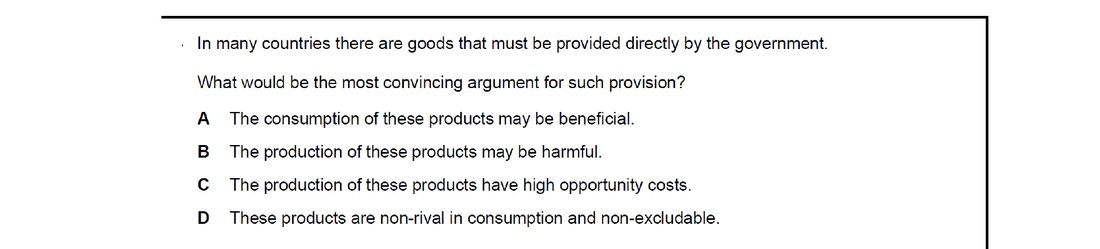
Direct state provision is appropriate when free markets fail to supply enough of a good. Option D – products that are non-rival and non-excludable – describes pure public goods, where private supply is impossible because of free-riding, so government must supply directly. The other options would justify taxes, subsidies or regulation, not necessarily direct provision.

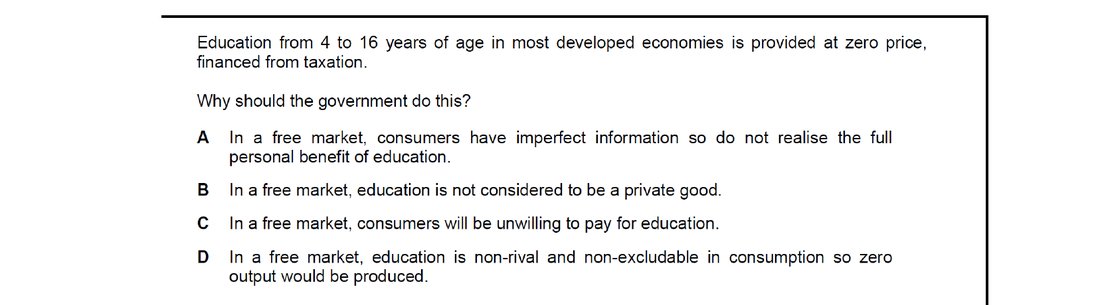
Externalities are spillover effects on third parties; education generates positive externalities (productive workforce, social cohesion) that individuals undervalue. Option A – consumers are not fully aware of the benefits of education – identifies this information failure / merit-good externality argument. Option B reverses the consumption direction, C misclassifies education as a public good, and D inverts the private-cost-benefit relationship.

Merit goods are under-consumed because individuals undervalue private benefits or because positive externalities exist. Option D – some consumers do not fully recognise the value of education – identifies the information/merit-good failure that justifies government intervention. A is a distributional, not allocative, point, B is a value judgement without theory, and C inverts the social cost-benefit relationship.
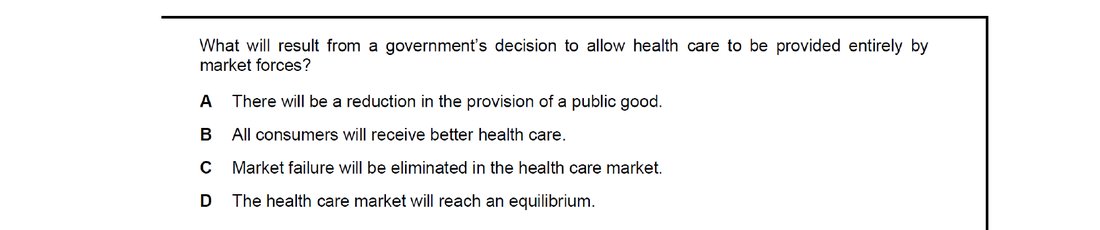
Leaving health care entirely to the market would still produce an equilibrium of price and quantity at the intersection of D and S. Option D – the market reaches equilibrium – describes the mechanical outcome. It would, however, under-supply care (so A and C are false), and not everyone would benefit, since only those able to pay would obtain treatment (B false).
Attempt the practice questions above to build your score.
Self-evaluation checklist
After studying this chapter, you should be able to:
- Define market failure and identify its main types.
- Explain why public, merit, and demerit goods cause market failure.
- Explain why governments use price controls and what happens diagrammatically.
Want more practice? Drill this chapter's past-paper MCQs (16 questions) →